

Why Apps, App Stores, and even the Web are about to Vanish
The Interface Was Always Temporary Scaffolding
Apps and web interfaces were never the value proposition. They were the scaffolding we built because we had no other way to access the data underneath. Every menu, every button, every carefully designed screen represents a compromise between what you want and what the machine can understand. For decades, we accepted this compromise as inevitable. We installed apps that consumed gigabytes of storage, learned keyboard shortcuts for features we'd use once, and paid monthly subscriptions for bloated platforms where we needed only two or three capabilities. The app was never the value. The data was. Your customer records in Salesforce, your financial models in Excel, your photos in cloud storage - these are the things that matter. The interface you click through to reach them does not.
OpenAI's new Codex Sites capability demonstrates this separation clearly. You simply describe what you need - a dashboard, a review workspace, a project tracker - and within minutes, a working application appears with database, authentication, and deployment. The interface exists only as long as the task requires it. When you're done, it dissolves. This is not an incremental improvement to how we build software. It is the recognition that software interfaces were always temporary infrastructure, and the era requiring their permanence has ended.
The UI Tax: Clicking Through Menus for Simple Answers
Every software interaction carries what I call the UI tax: the cognitive overhead of navigating interfaces designed for general use rather than your specific need. You open Photoshop's 4GB installation to crop one image. You click through five menus in your CRM to answer a question that should take five seconds. You learn Slack's threading model, Excel's pivot table interface, and Figma's layer system - not because these paradigms serve your goal, but because the software demands you learn its language.
Chat interfaces promised to eliminate this tax. Just tell the AI what you want. But chat alone creates a different problem. As Rush Team observed, you can express intent perfectly in natural language - "remove the background from this photo" - but you cannot iterate on text. You cannot drag a slider in a paragraph. You cannot click a checkbox in a summary. Chat gave us understanding without interactivity. Traditional apps gave us interactivity without understanding. Both extracted a tax.
The synthesis eliminates it entirely. Express your intent in natural language, and the system generates a custom interface for that exact task - not a generic screen with 500 options, but controls tailored to this problem, assembled on-demand. Use it then let it disappear. No installation, no learning curve, no subscription. The UI tax ends when interfaces become ephemeral.
Phase One: Platforms Go Headless
The transformation is already underway, and it is not subtle. Salesforce launched Headless 360 in April 2026, exposing its entire Customer 360 platform as APIs designed for AI agents rather than human users . The company explicitly positioned this as "agent-first workflows" where software agents execute business processes by invoking APIs directly, without interfaces. SAP faces the same pressure. While the company has been slower to expose semantic access to agents, the architectural direction is clear: enterprise platforms must become data and logic layers that agents can call, not applications that humans navigate.
This is Phase One. The platforms go headless. They expose everything - customer data, workflows, business rules, permissions -through APIs. The interface layer becomes optional. Humans can still open a dashboard if they want. But increasingly, they won't need to. An agent retrieves the information, interprets the context, and completes the task.
Deloitte's 2026 Technology Predictions noted that as agentic AI capabilities mature and enterprise SaaS vendors build out platforms to create, integrate, and orchestrate AI agents, how organisations purchase and use software will shift dramatically . Subscriptions and seat-based licensing are giving way to usage-based and outcome-based pricing. The reason is simple: when agents do the work, you do not need seats. You need API calls.
Phase Two: The Platform Becomes the Middleman
Phase Two is more radical. The platform itself becomes optional. When agents can generate working applications on-demand, the distinction between "using Salesforce" and "generating a CRM for this specific workflow" collapses. Healthcare makes this easier to see because it exposes the limits of the app model more clearly than most sectors. Clinicians work across fast-changing contexts, need hands-free or low-friction interactions, and cannot afford to stop and navigate a stack of separate applications while standing with a patient. In that setting, the value is not the app screen. It is secure access to the right patient records, the right workflow, and the right action in the moment. Project Solara, unveiled by Microsoft at Build 2026, exemplifies this shift. Microsoft presented it as a platform for devices that run AI agents instead of apps, using agents to avoid the constraints of traditional software. One concept device is a desktop hub that responds to voice commands, surfaces priority items, and becomes a full Windows machine in the cloud when needed. Another is a wearable badge that, in Microsoft's healthcare demonstration, scanned patient QR codes, recorded and transcribed visits, logged vitals, and initiated prescriptions without relying on installed applications. The device does not run apps. It runs agents that generate the interface required for each task, then discard it. This is the future Satya Nadella described when he argued that business applications are collapsing into an AI layer, with logic moving out of fixed applications and into agents that operate across systems. The application as a permanent artifact disappears. What remains is the orchestration layer: the platform that manages identity, permissions, data access, and agent coordination. The platform does not provide the interface. It provides the substrate on which agents generate interfaces when needed. Salesforce survives for now not because you open its dashboard, but because it owns your customer data and the permissions governing who can access it. The platform becomes middleware.
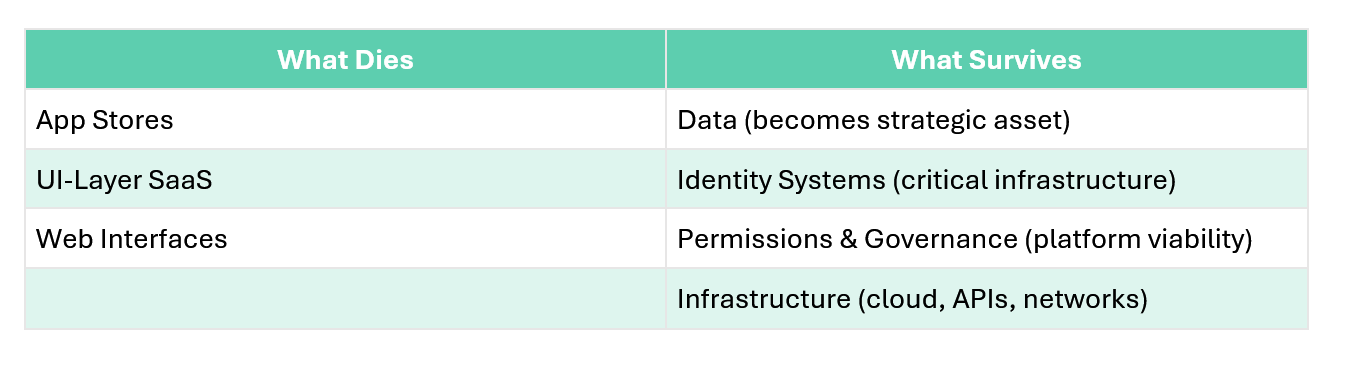
What Dies: App Stores, UI-Layer SaaS, the Web Interface
Let's be specific about what disappears. App stores die. You will not browse curated collections of permanent applications because permanent applications will not exist. Apple launched a web-based App Store in November 2025, finally allowing users to browse apps through a browser after seventeen years of device-locked access. The timing is ironic. Just as Apple makes its walled garden slightly more open, the entire model of downloadable, installed applications is becoming obsolete. When software is generated on-demand, there is nothing to download. UI-layer SaaS dies. Any platform whose value proposition is "a nice interface for managing X" will be replaced by agents that manage X directly through APIs. Bain's 2025 analysis warned that generative and agentic AI are already automating SaaS workflows: drafting code, handling support tickets, preparing journal entries, writing ad copy . The question for every SaaS provider is whether AI will enhance their offering or replace it entirely. If the core value is the interface, replacement is inevitable. The web interface layer will go. Not the internet - the infrastructure survives and becomes more critical. But the paradigm of opening a browser, navigating to a URL, and clicking through pages designed for general audiences ends. Interfaces become contextual, temporary, and generated for your specific need at that moment. This is not incremental change. This is the complete disappearance of software as we have known it for fifty years.
What Survives: Data, Identity, Permissions, Infrastructure
Four things survive and become more valuable.
Data Becomes the Strategic Asset
Every company that owns proprietary data - customer records, transaction history, domain-specific knowledge - holds leverage in an agent-driven world. Agents can generate interfaces, but they cannot generate your data.
Identity and Access Control Become Critical Infrastructure
When agents operate autonomously, the question of who they represent and what they are allowed to do becomes paramount. NewCore raised $66 million earlier this month (June 2026) specifically to solve this problem: how to authenticate, govern, and control AI agents at scale. Goldman Sachs tested AI coding agents as employees, and McKinsey reported 25,000 AI agents working alongside 60,000 human employees. These agents need identity systems, permission models, and revocation mechanisms.
Governance and Permissions Separate Viable Platforms from Obsolete Ones
Salesforce's Headless 360 survives because it manages not just data access but role-based permissions, compliance logging, and audit trails. The platform that controls what agents can read, write, and execute becomes indispensable.
Infrastructure Becomes the Foundation
The internet does not disappear. It becomes the substrate on which ephemeral software runs. Edge computing, API gateways, and orchestration engines handle the generation, execution, and disposal of temporary applications. The interface layer vanishes. The infrastructure layer becomes everything.
Make it stand out
Whatever it is, the way you tell your story online can make all the difference.
The defining characteristic of the new paradigm is ephemerality. Software exists only as long as the task requires it. Odokai introduced the term "ephemeral software" in April 2026 to describe software created quickly to solve a specific problem, used for that purpose, then removed without drama . Think of it as spinning up a temporary capability: a mini-app for a project phase, a workflow for a customer escalation, a collaboration space for a one-time event . The reason ephemeral software was not realistic before is that every application had to solve authentication, permissions, security, standards, and interoperability independently . When you had to solve those concerns inside every app, you built large, monolithic systems designed to last years. When the platform owns security, identity, and interoperability, teams can create and discard software as easily as they spin up a conversation.
OpenAI’s new Codex Sites demonstrates this model in production. You describe a tool, and Codex generates a working app with database, user authentication, and cloud hosting. The deployment URL is live immediately. You use it for the meeting, the project, the quarter. Then you let it expire. No maintenance burden, no technical debt, no subscription renewal. The software was ephemeral. The data it generated persists in your systems. The interface does not.
Strategic Implications: Consolidate and Structure Your Data
If you accept this trajectory, the strategic implications are clear. Treat data as your only durable asset. Interfaces will be generated. Infrastructure will be commoditised. The data you own - customer relationships, transaction history, domain expertise - is the only moat that persists. Consolidate it. Structure it. Make it accessible through clean APIs. Invest in identity and permissions infrastructure. In a world where agents act autonomously on your behalf, the systems that authenticate those agents and control their permissions become critical. This is not a feature to add later. It is foundational architecture. Stop paying for interface bloat. Evaluate every SaaS subscription and ask: am I paying for data, logic, and access control, or am I paying for a UI that agents will soon bypass? If the answer is the latter, find the API-first alternative or prepare to migrate. Build for agent interoperability, not human dashboards.
The next generation of enterprise software will be designed for agents to call, not for humans to navigate. APIs, structured data models, and semantic interfaces matter more than visual design.
Prepare for outcome-based pricing. When agents replace human users, seat-based licensing becomes irrelevant. The shift to usage-based and outcome-based models is already happening. Budget accordingly.
